Your whiteboard is faster than our software.
For one change.
Rub it out, write it somewhere else, and everyone in the room knows. Three seconds, no login, nothing to learn, and it has never once been down for maintenance.
We are not going to pretend otherwise. What we would like to show you is what happens in the twenty minutes after those three seconds, because that part is not on the wall, and it is the part that costs you.
The three seconds, and the twenty minutes
You move a booking from two o’clock to four. Here is everything the whiteboard did not do.
- The student doesn’t know. Somebody rings them, or somebody doesn’t, and they drive forty minutes to an aerodrome for a flight that moved.
- The instructor doesn’t know. They’re airborne. They find out when they land.
- Nobody checked whether the new slot was legal. Is the instructor’s rating still valid on the new date? Is the medical? Is the instructor over duty by half four? Is a solo now after sunset? Does the aircraft’s check now fall due mid-flight, and is that inside the tolerance in your maintenance programme or past it? The whiteboard will let you write anything in the box, and it doesn’t know that it can’t check.
- The invoice is built from memory. At month end someone reconstructs what flew from the tech log, the sheets and their recollection. Every reconstruction leaks a little.
- The board is wiped at six. So there’s no record the change happened. When a student says you’ve moved them three times this month, nobody can say whether that’s true.
- Nobody can answer a question about last month. Not one.
Three questions, and we’d rather you answered them to yourself
How many hours did your busiest aircraft fly last month, and how many could it have?
How many lessons went for weather in June, and how many went for tech?
When did you last move a booking and the student turned up anyway?
If the first two are easy to answer, you have a system somewhere and we are less useful to you than we think, which is worth knowing before you spend an hour with us. If they’re not, that’s the gap. The third one has happened to everybody.
A whiteboard will let you write anything in the box
Drag a booking to four o’clock in FlyerOS and it checks the flight at four o’clock, not at the moment you dragged it. If something makes that flight impossible, it refuses, names the reason, and puts the card back where it came from.
“L. Novak is cleared for solo, day only. Moved to four o’clock, this flight would land after night begins.”
And where the rule has a tolerance, it says so rather than pretending it does not:
“G-FLYD’s 50-hour check falls due at 4,821.6 hours. This flight is forecast to land at 4,823.1, inside the 10-hour tolerance in your maintenance programme, so it’s your call. The next interval runs from the actual inspection, not from the due point.”
That’s not a feature we added to be clever. It’s the whole reason the system exists, and it is the sort of thing a marker pen cannot do for you at any speed.
The move itself is one drag. No dialog, no confirmation box, no page reload. It’s reversible with one click, and it’s recorded: who moved it, from where, to where, and when.
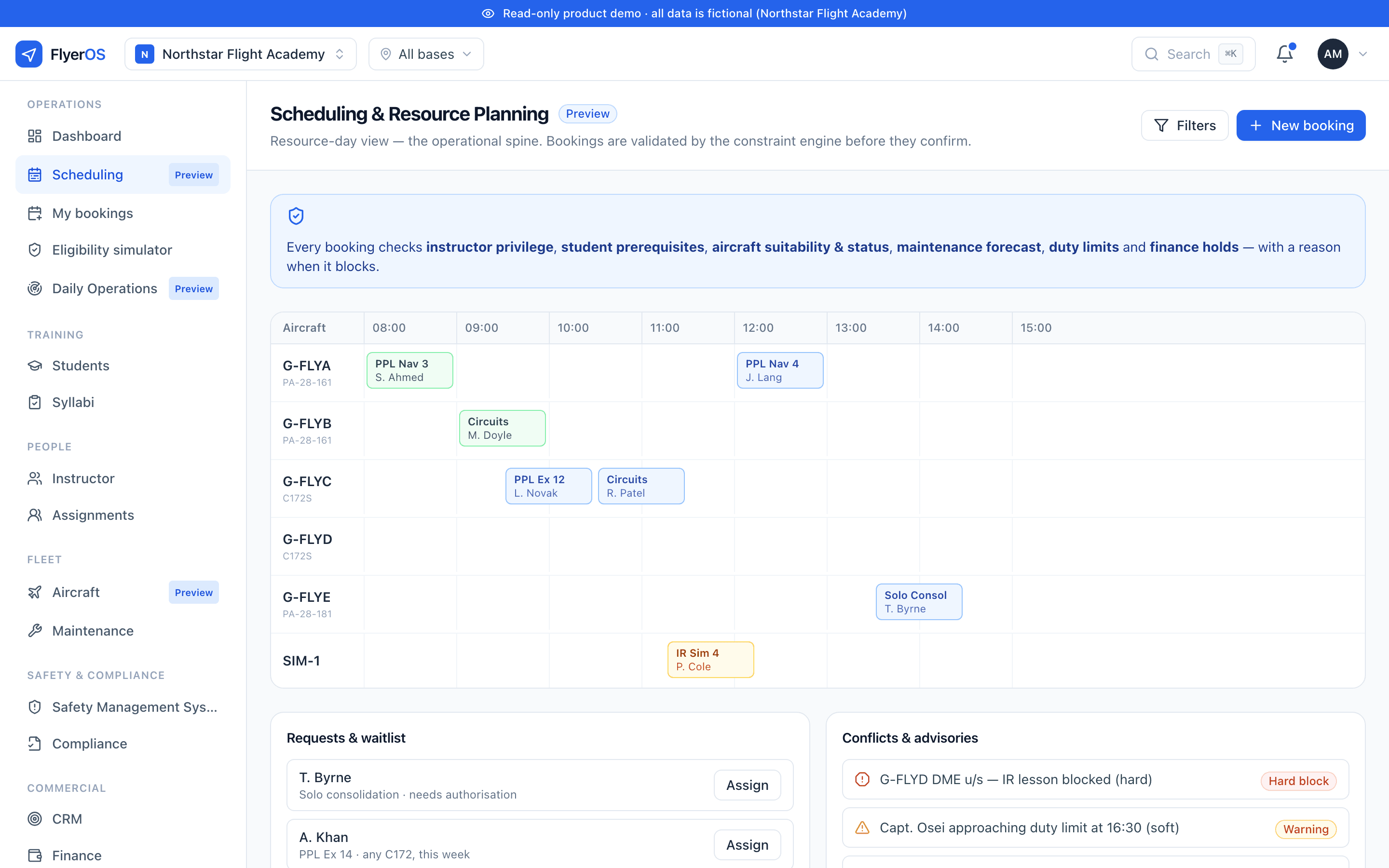
Keep the wall. Change what’s on it.
The best thing about a whiteboard is that it’s on the wall. Nobody opens it, nobody logs into it, nobody chooses to look: everyone walking past absorbs the day without deciding to. That’s genuinely valuable, and most software throws it away by living inside a laptop.
So we didn’t. FlyerOS puts a screen where your whiteboard is: today’s aircraft, today’s flights, big enough to read across the room, updating through the day as the schedule changes. Same wall, same glance, same instructors walking past and taking it in.
The difference is that this wall also raised the invoice, checked the flight was legal, told the student, and remembered it in the morning.
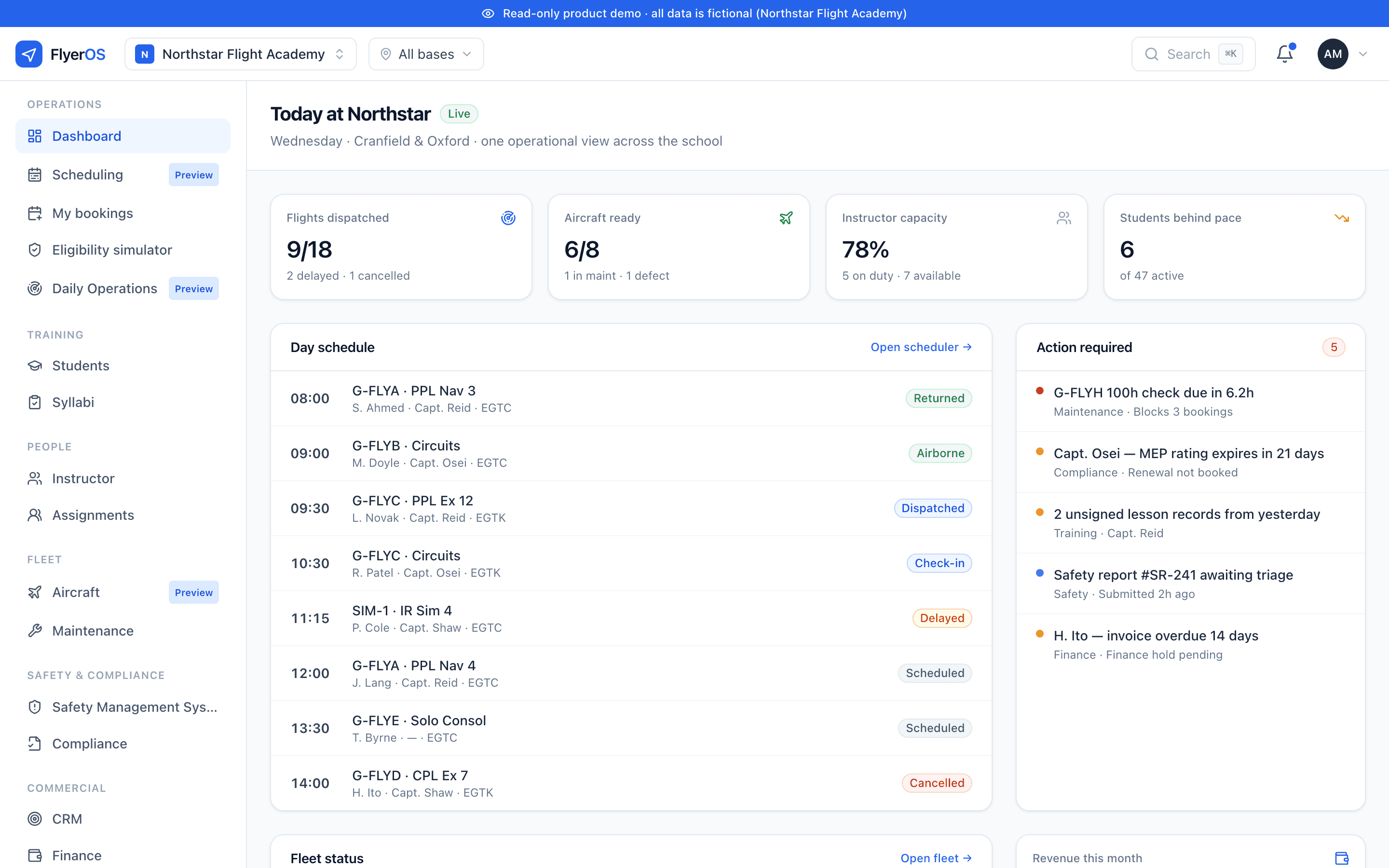
We’re not asking you to take the whiteboard down
Run FlyerOS alongside it for two weeks. The board stays on the wall and stays the thing you trust. We’ll load your aircraft from the register before we start, so you’re looking at your own fleet on day one, not a demonstration school.
Then the test, and we’d rather set it now than argue about it later: if after two weeks your office is still looking at the wall more than the screen, we haven’t earned it, and you should keep your whiteboard.
No card, no contract, nothing to cancel.
“It’ll be slower than the pen.”
For the first fortnight, yes. Somebody has to learn where things are, and a pen has no learning curve. After that it’s one drag instead of a rub-out, a phone call, a text message and a note to remember at month end. We’d rather say that plainly now than have you find it out in week one and conclude we oversold it.
“What happens when it goes down?”
Rarely. We target 99.9% availability, and the server-side maintenance that does happen runs in the small hours, not during your flying day. On the odd occasion it is down, you print the day and carry on: the schedule, who’s flying what, and the state of every aircraft, on paper, so a bad day for us isn’t a bad day for you. And for the first month the whiteboard is still on the wall anyway.
“The whiteboard is free.”
The board is. The afternoon somebody spends on the phone after every change isn’t, and neither is the aircraft hour nobody sold because nobody could see the gap. For a school of your size this comes to a fraction of a percent of turnover, and roughly what one no-show a week costs you. We’d rather you worked that out yourself than take our word for it, which is what the pricing page is for.
Sixteen rows and eight slots is a hundred and twenty-eight boxes
A whiteboard is brilliant at four aircraft. By sixteen it’s a hundred-odd boxes to read across a room, and by Friday afternoon half of them have been written over twice.
You already know that. We’re not telling you anything about your own operation you haven’t noticed. We’re saying there’s a version where the wall still tells everyone what’s happening, and the change takes one movement, and somebody catches it when the change would have put an out-of-check aeroplane in the air.
Two weeks, alongside what you’ve got. Then decide.